What Is Space Opera? A Beginner's Guide
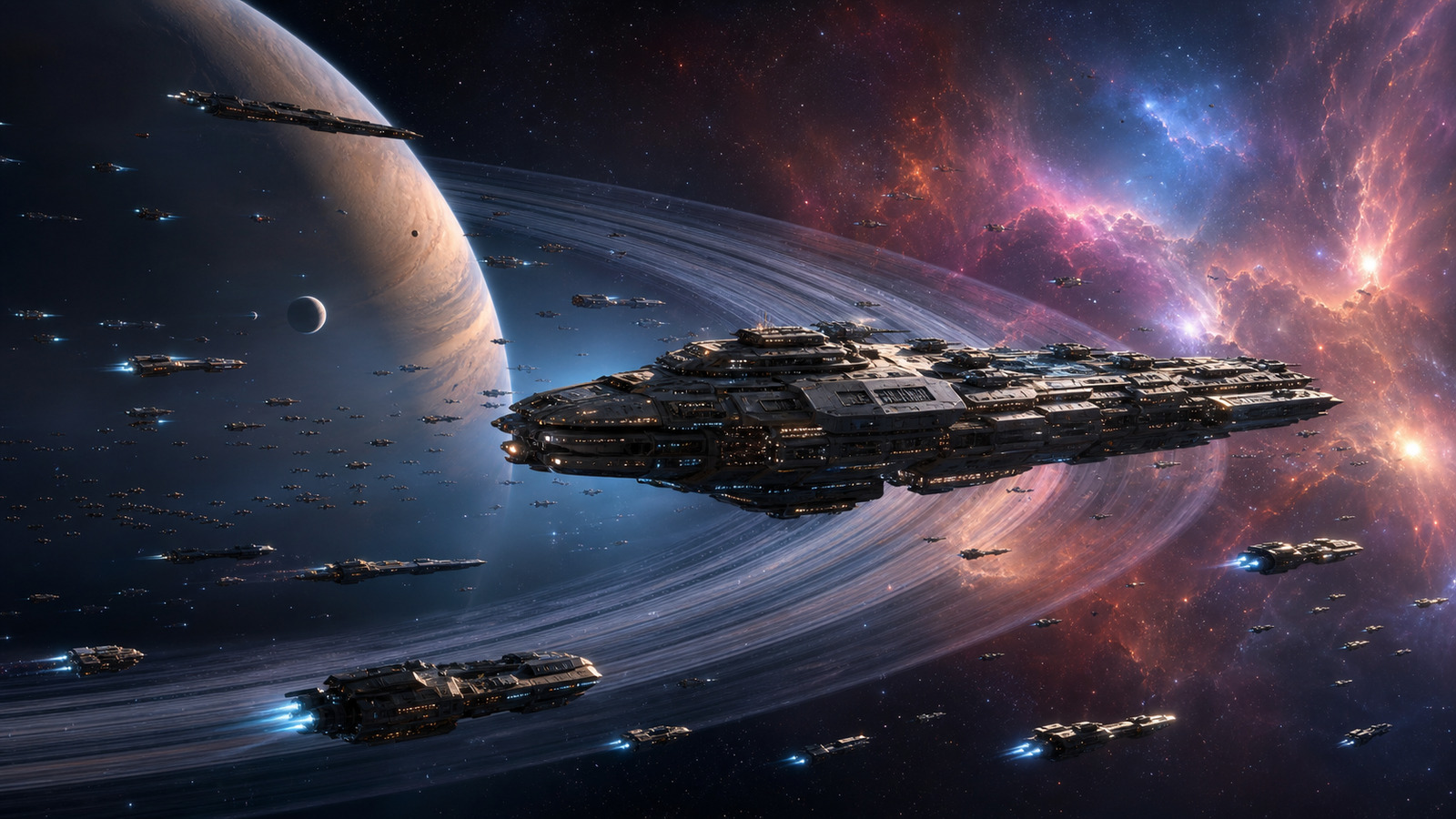
So what is space opera, and why does it shape so many people’s idea of science fiction in the first place? From Star Wars to Dune, it is the genre’s grandest and most popular mode — and a wonderful place to fall in love with SF. This guide defines it, contrasts it with harder science fiction, lists its classic ingredients, and points you to the essential books and shows.
Space opera, defined
The short version of what is space opera: it is science fiction that trades rigor for scope. Think galactic empires, interstellar wars, ancient alien mysteries, and heroes whose choices decide the fate of worlds. The science is a stage, not a subject.
The name has a funny history. Writer Wilson Tucker coined “space opera” in 1941 as an insult, echoing “horse opera” for a cheap Western and “soap opera” for daytime melodrama. The label stuck, lost its sting, and is now worn with pride.
It's about scale and adventure
If a story feels operatic — big emotions, bigger stakes, and a canvas the size of a galaxy — you are in space opera territory. The mode loves grand gestures: fleets clashing over a planet, a lone crew carrying the hopes of a civilization, a secret that rewrites history.
That scale is the appeal. Space opera hands you wonder and momentum in the same breath, which is why it is so often the doorway that pulls new readers into the genre in the first place.
How it differs from hard SF
The clearest way to place space opera is against its opposite. Where hard science fiction treats physics as a rulebook, space opera treats it as set dressing — faster-than-light travel simply works, and the story keeps moving. Neither is better; they chase different pleasures, as our cornerstone guide to hard vs soft science fiction explains.
| Aspect | Space opera | Hard SF |
|---|---|---|
| Priority | Scope, adventure, emotion | Scientific plausibility |
| FTL travel | Assumed, rarely explained | Avoided or carefully justified |
| Scale | Galaxies and empires | Often a single ship or world |
| Feels like | Myth and legend in space | An engineering problem |
Common ingredients
Most space operas mix and match from a familiar toolbox. You do not need every item, but you will recognize them fast.
- Faster-than-light travel that shrinks the galaxy to a manageable map.
- Sprawling empires, federations, or republics locked in conflict.
- A found-family crew aboard one beloved ship.
- Aliens, ancient artifacts, and civilization-ending stakes.
- A rebel, a smuggler, or an outsider swept up in history.
Some of these ideas have their own deep traditions — the long-haul starship, for instance, earns a whole subgenre in our look at generation ship stories.
Foundational space opera
The mode has deep roots, and much of it still reads beautifully today. These books built the tradition.
| Book or series | Author | Why it’s essential |
|---|---|---|
| Foundation | Isaac Asimov | The fall and rebirth of a galactic empire, told through ideas. |
| Dune | Frank Herbert | Political and ecological space opera on an epic scale. |
| The Culture series | Iain M. Banks | Wildly inventive novels of a post-scarcity galactic society. |
| The Vorkosigan Saga | Lois McMaster Bujold | Character-first adventure with wit and real heart. |
Modern space opera
The mode is thriving right now, often with sharper politics and a wider cast than the classics. A few modern favorites worth your time:
- Leviathan Wakes by James S. A. Corey — the grounded, gripping start of The Expanse.
- Ancillary Justice by Ann Leckie — empire and identity narrated by a former warship.
- A Memory Called Empire by Arkady Martine — intrigue, language, and culture at an imperial court.
- The Long Way to a Small, Angry Planet by Becky Chambers — warm, character-driven, and welcoming.
Space opera on screen
Space opera rules the screen as much as the shelf. Star Wars is the purest example — mythic, sweeping, and gloriously unconcerned with physics — while Star Trek pairs adventure with optimism and ideas.
For something grittier, Battlestar Galactica and the television adaptation of The Expanse keep the scale while grounding the politics, and lighter fare like Guardians of the Galaxy proves the mode can simply be a blast.
Frequently asked questions
Is Star Wars space opera?
Absolutely — it is the most famous space opera there is. The galaxy-spanning stakes, mystical elements, and rousing adventure are textbook features. Some fans also call it science fantasy, because the science is pure backdrop, and both labels fit comfortably.
What is the difference between space opera and hard science fiction?
Space opera prioritizes scope, emotion, and adventure, and it happily assumes conveniences like faster-than-light travel. Hard SF instead treats real science as a constraint the plot must respect. Our cornerstone guide walks through the full spectrum between them.
Is space opera the same as science fantasy?
They overlap but are not identical. Space opera is defined by scale and adventure; science fantasy is defined by blending SF trappings with outright magic or myth. A story like Star Wars is both at once, but plenty of space opera stays firmly science-flavored.
Where should I start with space opera?
For a modern on-ramp, try Leviathan Wakes or The Long Way to a Small, Angry Planet; for a classic, reach for Dune. Our beginners’ reading guide has more gentle first picks.
Grand, romantic, and endlessly re-inventable, space opera is where science fiction lets itself dream biggest — and it is a perfect place to begin. When you want to see how it sits alongside the genre’s other modes, start with our cornerstone guide.
Last updated: July 6, 2026


Comments
Post a Comment