What Is Cyberpunk? The Subgenre Explained
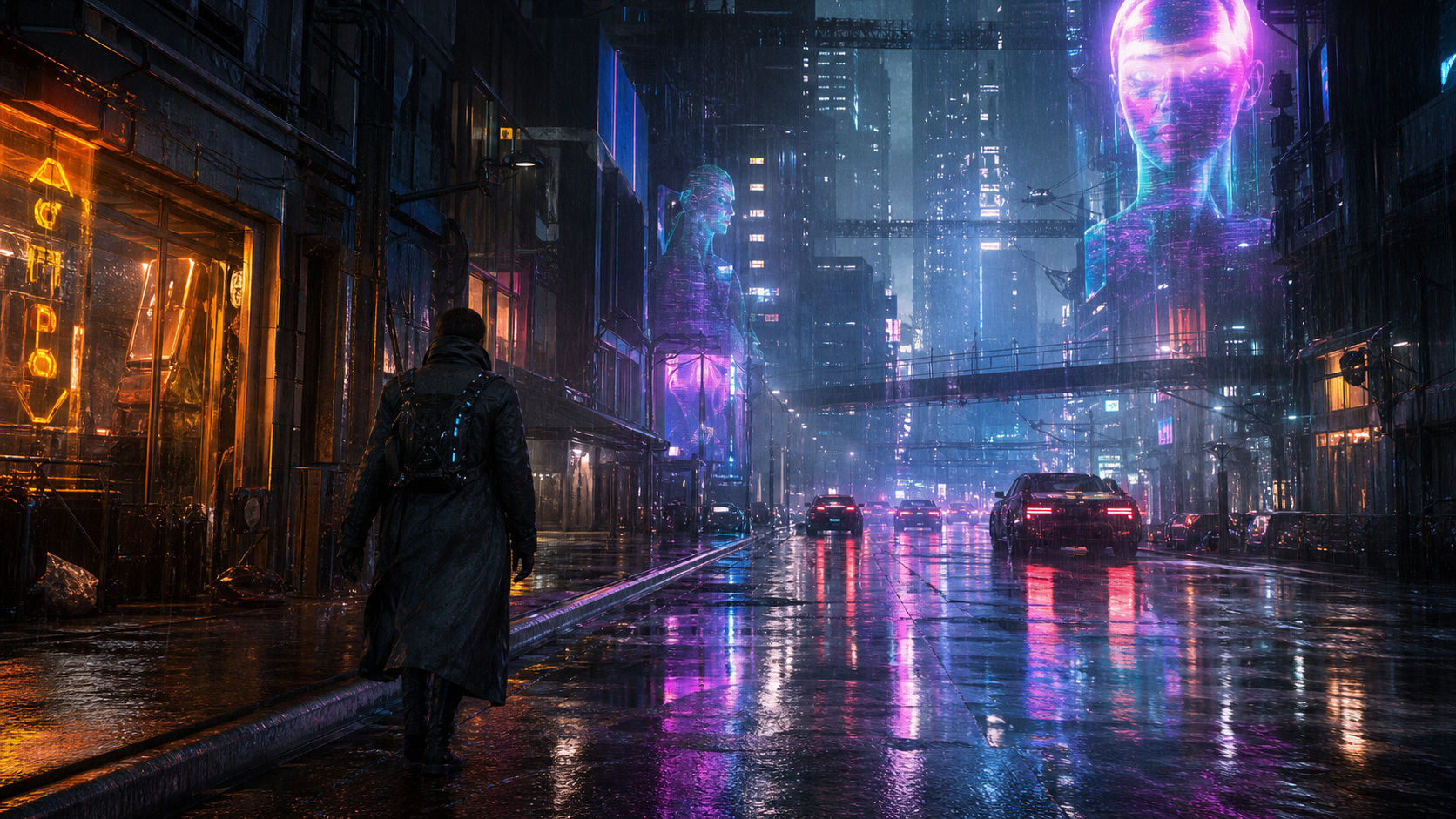
If you’ve ever seen a rain-slicked street glowing with neon and wondered exactly what is cyberpunk, you’re asking about one of science fiction’s most influential and instantly recognizable modes. This guide is for anyone who loves the look but wants to understand the ideas underneath it. We’ll cover the heart of the subgenre, where it came from, its themes and aesthetic, and the books and films that define it.
Cyberpunk in one phrase: high tech, low life
The fastest answer to what is cyberpunk is the movement’s own slogan: “high tech, low life.” These are futures of dazzling technology — artificial intelligence, cybernetic implants, global networks — experienced by ordinary people scraping by at the bottom of a society run by corporations rather than governments.
That tension is the whole point. The gadgets are miraculous, but they do not save anyone; power stays concentrated at the top while the streets stay grim. Cyberpunk asks what technology feels like when you are not the one who owns it.
- High tech — AI, cyberware, virtual reality, and networks everywhere.
- Low life — hackers, hustlers, and outsiders living in the corporate shadow.
Where cyberpunk came from
The subgenre crystallized in the early 1980s. The word itself comes from a 1983 short story by Bruce Bethke titled “Cyberpunk,” and editor Gardner Dozois helped popularize it as a label for a new wave of writers.
William Gibson’s Neuromancer (1984) is the book that set the template — console cowboys, cyberspace, and corporate intrigue. Bruce Sterling’s anthology Mirrorshades gathered the movement in one place, and its roots reach back to the paranoia of Philip K. Dick and the shadows of film noir.
Core themes: power, tech, the body
Beneath the neon, cyberpunk keeps circling the same few big questions.
- Corporate power — megacorporations replace nations as the real authorities.
- The hackable body — implants and prosthetics blur where the person ends and the machine begins.
- Information as power — data, code, and access matter more than land or gold.
- Artificial minds — AIs that may be smarter, and freer, than their makers intended.
That last thread runs straight into the genre’s long fascination with machine minds — a story we trace in our guide to AI in science fiction.
The aesthetic
Ask what is cyberpunk and many people describe a look before a plot: perpetual night, rain on chrome, towering megacities lit by holograms and multilingual signage, and characters in mirrored shades and worn leather. Ridley Scott’s Blade Runner (1982) hardwired that image into the culture.
The style mixes the sleek and the broken on purpose — cutting-edge tech duct-taped onto decaying streets. It is a future that is glamorous and miserable at once, which is exactly the mood the stories are chasing.
Foundational books
If you want to read the real thing rather than just admire the posters, start with these.
| Book | Author | Why it matters |
|---|---|---|
| Neuromancer | William Gibson | The cornerstone; it named cyberspace and set the tone. |
| Snow Crash | Neal Stephenson | Faster and funnier; it popularized the idea of the metaverse. |
| Do Androids Dream of Electric Sheep? | Philip K. Dick | The proto-cyberpunk source behind Blade Runner. |
| Synners | Pat Cadigan | A sharp, character-rich take from a leading voice of the movement. |
Cyberpunk on screen
Cyberpunk may be even more famous on screen than on the page. Blade Runner supplied the visual DNA, and the Japanese animated films Akira (1988) and Ghost in the Shell (1995) pushed it further, wiring the body and the network together.
The Matrix (1999) took the ideas mainstream, and more recent work — Blade Runner 2049, the series Altered Carbon, and the game Cyberpunk 2077 — shows the look and its questions are as durable as ever.
Post-cyberpunk and offshoots
As the future the genre imagined started arriving, writers adapted. “Post-cyberpunk” keeps the technology but trades pure despair for characters trying to build something within the system — Neal Stephenson’s The Diamond Age is a good example.
The “-punk” suffix also spun off a whole family of aesthetics, each swapping in a different signature technology.
- Steampunk — Victorian machinery and brass-and-steam invention.
- Biopunk — genetic engineering and wetware instead of circuitry.
- Solarpunk — a hopeful, green counter to cyberpunk gloom.
If you enjoy sorting these labels, our piece on post-apocalyptic subgenres untangles another cluster of them.
Frequently asked questions
What does the word “cyberpunk” actually mean?
It fuses “cyber,” from cybernetics and computer networks, with “punk,” the anti-establishment attitude of the outsiders at its center. Together they capture the genre’s mix of high technology and rebellious, street-level grit. The term dates to the early 1980s.
Is Blade Runner cyberpunk?
Yes — it is one of the most influential cyberpunk works, even though it arrived two years before Neuromancer. Its rainy megacity, replicants, and corporate power defined the look for everything that followed. It is essential viewing for understanding the subgenre.
What is the difference between cyberpunk and steampunk?
Both pair advanced technology with a distinct culture, but they live in different eras. Cyberpunk is a near-future of computers and cybernetics; steampunk reimagines the past with Victorian steam-powered machines. The mood differs too — cyberpunk is gritty, while steampunk is often adventurous.
Which cyberpunk book should I read first?
Start with Neuromancer if you want the foundational text, though its dense style rewards patience. If you would rather have fun on the first try, Snow Crash is faster and wickedly funny. Either one shows you what the genre does best.
So the next time neon reflects off wet pavement, you will know that what is cyberpunk goes deeper than a look: it is a warning about who controls our tools and who gets left behind. For the big picture of where it sits in the genre, start with our cornerstone guide.
Last updated: July 6, 2026


Comments
Post a Comment