Hard vs Soft Science Fiction: What's the Difference?
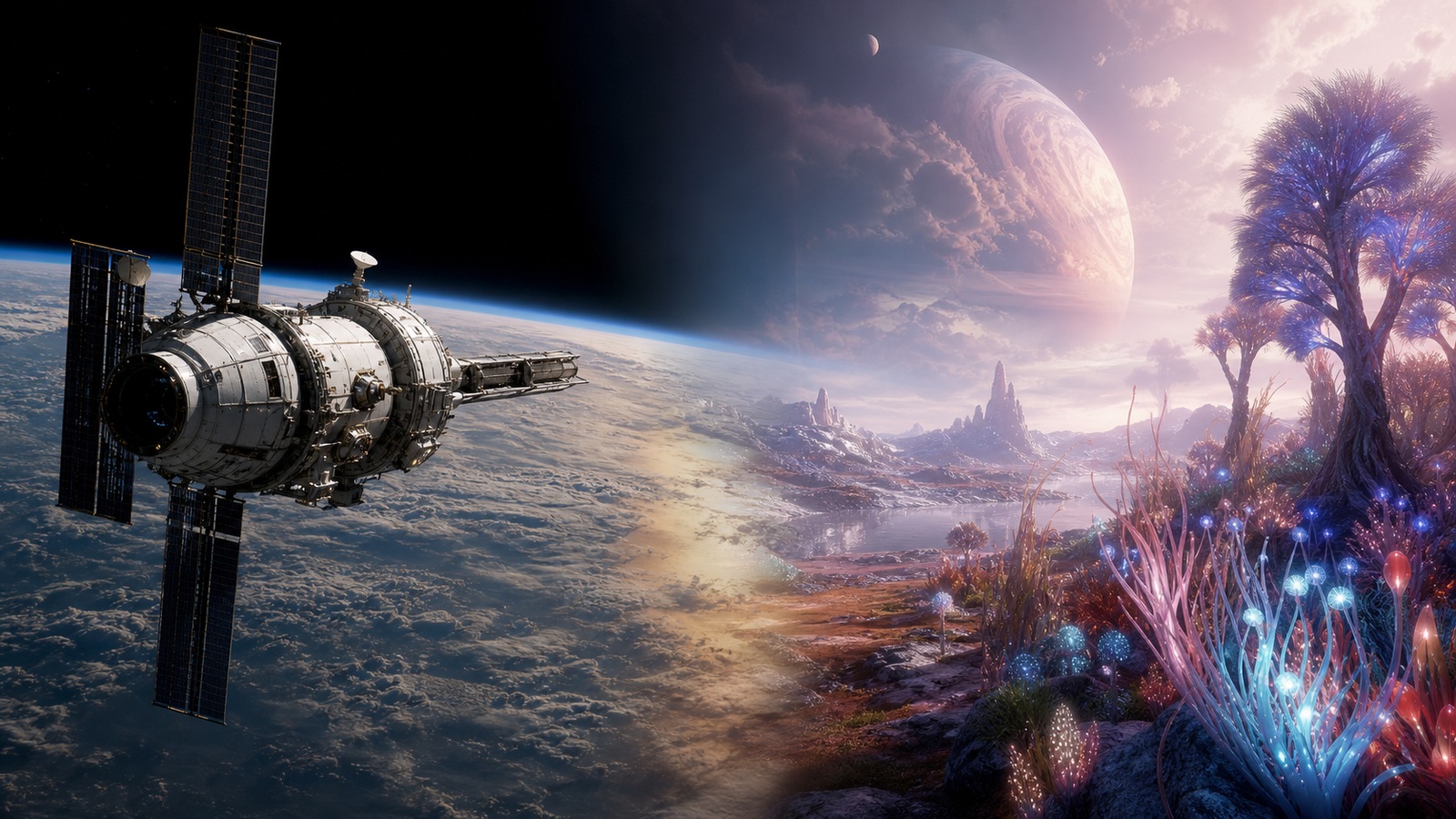
The debate over hard vs soft science fiction is the friendliest long-running argument in the genre, and it also happens to be the most useful map a newcomer can carry. If you’ve ever wondered why The Martian feels so different from Dune even though both sit on the same shelf, you’re in the right place. This guide defines both ends of the scale, explains why they’re really a spectrum rather than a wall, and hands you a shelf of examples so you can find your own taste.
The one distinction fans argue about
Ask ten readers to explain hard vs soft science fiction and you’ll get ten slightly different answers, which is exactly why the debate is so durable. The rough consensus is simple, though: hard SF keeps its science plausible and load-bearing, while soft SF is happy to wave a hand at the physics so it can chase a human or philosophical question instead.
The key thing to hold onto is that neither label is a grade. Calling a book “soft” is not an insult, and “hard” does not mean “better written.” The two words simply describe where a story chooses to spend its attention.
| Aspect | Hard SF | Soft SF |
|---|---|---|
| Puts first | Scientific plausibility | Character, society, theme |
| Treats science as | A rulebook to obey | A backdrop or metaphor |
| Typical question | “How would this actually work?” | “How would this change us?” |
| Reader payoff | The thrill of a fair puzzle | Emotional and cultural resonance |
Hard SF: science as a constraint
On the hard side of the hard vs soft science fiction split, the defining feature is discipline. The writer accepts the known laws of physics as a fixed set of rules and then asks a single stubborn question: given those rules, what actually happens? Rockets need reaction mass, radio signals crawl at lightspeed, and orbital mechanics do not care about anyone’s deadline.
The pleasure here is watching a clever character solve a genuine problem without cheating. When Mark Watney turns Martian soil and leftover fuel into water in The Martian, the tension comes from the fact that the chemistry has to add up. Hard SF trusts that reality is interesting enough on its own.
- Real constraints — lightspeed limits, fuel budgets, and vacuum are honored, not hand-waved.
- Show your work — the plot often turns on a calculation the reader can almost follow.
- Extrapolation — new technology is built outward from science we already have.
Soft SF: people and ideas first
The soft end of the hard vs soft science fiction spectrum cares less about whether the drive works and more about who is aboard the ship and what their world believes. “Soft” can point toward the soft sciences — anthropology, sociology, psychology, linguistics — or it can simply mean the technology is set dressing for a human story.
Ursula K. Le Guin is the patron saint of this mode. In The Left Hand of Darkness, the science that matters is social: what happens to politics, love, and trust on a world where people have no fixed gender. The hardware is almost beside the point, and the book is a masterpiece because of it. None of this makes soft SF lightweight, either — some of the genre’s most demanding novels sit squarely on this end.
Why it's a spectrum
Here is the part the arguments usually miss: hard vs soft science fiction is not a switch with two settings, it is a dial, and most of the best books sit somewhere in the middle. A novel can be rigorous about orbital mechanics and completely invented about its aliens, or careful about biology and casual about its faster-than-light drive.
Dune is a useful example. Its ecology and politics are worked out in loving, almost scientific detail, yet it also contains prophetic visions and a fold-space drive with no real physics behind it. Frank Herbert simply spends his rigor where it serves the story, which is the norm rather than the exception.
- Firmly hard — The Martian, Red Mars
- In the middle — Dune, The Three-Body Problem
- Firmly soft — The Left Hand of Darkness, The Martian Chronicles
Classic hard SF examples
If you want to feel the appeal of rigor, these are the hard SF titles I hand people first. Each one earns its sense of wonder by playing fair with the science.
| Book | Author | Why it’s hard SF |
|---|---|---|
| The Martian | Andy Weir | One stranded botanist survives on real chemistry and arithmetic. |
| Rendezvous with Rama | Arthur C. Clarke | Explores an alien ship with an engineer’s sense of scale and awe. |
| Red Mars | Kim Stanley Robinson | Terraforming worked out with geology, politics, and receipts. |
| The Three-Body Problem | Cixin Liu | Real physics drives the plot, from orbital chaos to particle science. |
Beloved soft SF examples
And here are the soft SF novels I love most — books where the science opens a door and then steps aside so the people can walk through it.
| Book | Author | What it’s really about |
|---|---|---|
| The Left Hand of Darkness | Ursula K. Le Guin | Gender, culture, and trust on a world without fixed sex. |
| The Martian Chronicles | Ray Bradbury | Mood, memory, and colonial guilt told as linked fables. |
| Dawn | Octavia E. Butler | Survival, consent, and identity after a first-contact rescue. |
| The Player of Games | Iain M. Banks | Politics and morality inside a post-scarcity civilization. |
Which will you like more?
So which end of the hard vs soft science fiction scale should you reach for first? Follow the feeling you already enjoy. If you loved the nail-biting problem-solving of The Martian, start hard and let competence be the thrill.
If you were moved more by the cultures and characters of Dune, start soft and let the ideas do the heavy lifting. The happiest readers I know refuse to pick a side, and simply follow the best book in front of them.
Still not sure where to jump in? Our guide to the best sci-fi books for beginners pairs both ends of the scale with gentle first reads.
Frequently asked questions
Is hard science fiction better than soft science fiction?
No — they simply aim for different pleasures. Hard SF rewards you with the satisfaction of a puzzle that plays fair, while soft SF rewards you with emotional and cultural depth. Judging one by the other’s goals is how the endless arguments start.
Is Star Wars hard or soft science fiction?
Very soft — so soft that many fans call it science fantasy. The Force, the sound in space, and the instant hyperspace jumps exist to serve myth and adventure, not physics. That is a deliberate design choice, not a flaw.
Can a single book be both hard and soft?
Yes, and most of the great ones are. Dune and The Three-Body Problem both handle some science with real rigor while inventing freely elsewhere. The labels describe tendencies, not sealed boxes.
Where should a beginner start on the scale?
Start with whatever matches the stories you already enjoy on screen. If you like grounded survival tales, try hard SF; if you like character dramas, try soft SF. You can always cross over once you have a foothold.
Whichever end of the spectrum calls to you, the point of the hard vs soft science fiction map is not to sort books into winners and losers — it is to help you find more of what you love. Keep the dial in mind, ignore anyone who gatekeeps, and let your own taste choose the next great read.
Last updated: July 6, 2026


Comments
Post a Comment